The project is driven by Coompanion Gotland, Fårö Utveckling AB, and Heligholm Utveckling AB with support from Leader Gute.
In a first step, three initiatives have been made during 2024 within the project in the two areas:
• Surveys to all households that resulted in insights about what the residents think is most important to develop in their community. (See fact box 1 below)
• Large meetings where the survey results were presented, discussed, and led to concrete development issues that should be prioritized based on the survey responses.
• Collection of local statistics from SCB regarding primarily the areas' economy and demographics, to obtain a deeper basis for the continued work. (See fact box 2 below)
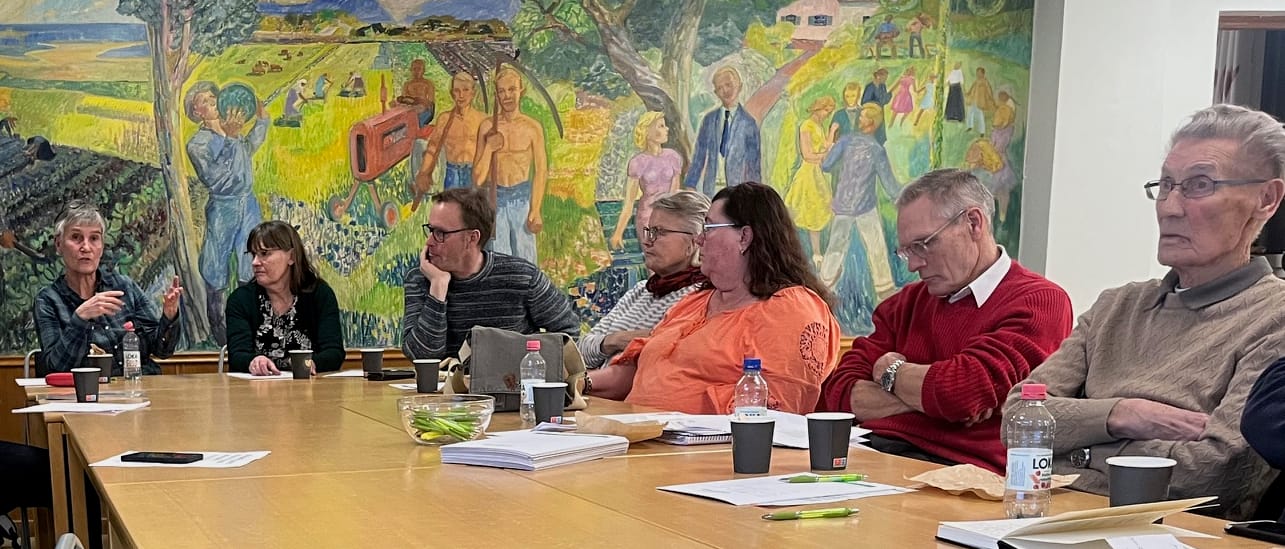
On February 6 this year, a joint meeting was held with representatives from both Fårö and Storsudret to share experiences and ideas and inspire each other (the image above).
In the spring, the next step will be taken: Meetings in the two areas, where local associations will be responsible for driving the prioritized development issues forward in concrete sub-projects.
When this work is completed, the results from the sub-projects in the two communities will be presented, as well as plans with local activities moving forward. Results and plans will be presented at meetings and in analog newspapers as well as in digital format.
”Built on local forces”
– Place development is an ongoing process, especially when moving in rural areas. The hope is, of course, that this project will contribute to making Fårö and Storsudret even better places to live and visit, says Anders Ahlin, CEO and advisor at Coompanion Gotland.
Coompanion Gotland is the project owner of ”Local economic analysis for local development Fårö/Heligholm” and Anders has the role of project manager. But he emphasizes that local anchoring and local engagement are fundamental.
– The project is built on local forces. The meeting with all the engaged people in Fårö and Storsudret in this project is incredibly inspiring. So many interesting ideas and opinions emerge about how to collectively develop their community. Collaboration truly brings strength, and that is also Coompanion's motto, says Anders.
The local coordinators in the project are Frans Brozén, Fårö Utveckling, and Tryggve Berling as well as Jan Larsson, Heligholm Utveckling.
Elderly care, public transport, and water supply are the most important for the residents of Fårö.
The three issues that the most people considered important in the survey in Fårö are elderly care in the local area, needs-adapted public transport, and secure water supply.
– The fact that elderly care ranks at the top is of course influenced by the fact that the population is getting older and that many want the opportunity to stay in Fårö as they age. But the fact that the issue was considered so urgent by so many may also have been partly due to the fact that the issue was raised in the media just when the survey was distributed, says Frans Brozén.
– The traffic issue is extremely important for Fårö. We want functioning public transport in Fårö all year round, even in winter. Ferry departures every half hour are a necessity, as well as safer cycling paths. Yes, the entire traffic structure in Fårö needs to be developed.
Frans sees the VA issue and water supply as a very central issue for Fårö.
– Municipal water is to be in place around Ekeviken by 2031. Municipal VA is to begin construction in 2031 according to the adopted plan in the Region 20250217 in the area Eke-Ekeviken-Fifang.
– But there are several things that need to be resolved. As it stands now, it is very difficult for permanent residents to obtain building permits. With the current comprehensive plan, it is not possible to get building permits because there is no public transport in the area…
Frans believes that the statistics produced regarding Fårö do not contain any major surprises but rather confirm and strengthen the image one has had. However, he sees a potential future change in a statistical figure.
– We know, for example, that we have an aging population. But the relatively high commuting out of the area that applies now may change if the military increases its activities in Fårösund again.
Public transport, rental apartments, and water supply are the most important on Storsudret
The three issues that most people on Storsudret consider the most important according to the survey there are needs-based public transport, more rental apartments, and secure water supply. Health care and schools are also highlighted by many in the survey.
– These were mostly expected priorities, say Tryggve Berling and Jan Larsson.
– Issues considered important include not least rental apartments and the region's efforts such as health care and schools, for example.
When it comes to the statistics produced about Storsudret, Tryggve and Jan see it as a confirmation that the housing issue really needs to be prioritized.
– We confirmed that the permanent population is decreasing and that part-time residency is increasing. Our prioritized effort to build properties that suit an increased permanent population is therefore on the right track.
Division of responsibilities and work forward
– I think our work has gone well initially, and now it is about moving forward. We have now started to distribute responsibility to various local associations for the prioritized development issues on Fårö. The VA issue will be driven by Fårö Development and the traffic issue by LRF and Fårö Community Association. At upcoming meetings, responsibility for other development issues will be distributed, says Frans, who hopes that the project will lead to new solutions and development in all development areas that they choose to work with on Fårö.
– In the near future, we will distribute the further work with the 15 highest priority areas we have identified for Storsudret, say Tryggve and Jan.
Different local organizations and associations will take on the various issues.
– Our vision is that solutions to all 15 prioritized development factors will become a reality within a few years.
FACT BOX 1
Survey responses on Fårö
A total of 152 people responded to the survey.
The issues that most marked as important are the following (number in parentheses):
• Elderly care in the local area (102)
• Needs-based public transport (101)
• Secure water supply (96)
• School in the local area (79)
• Local taxi service (77)
• Preschool (72)
• More rental apartments (67)
Survey responses on Storsudret
A total of 155 people responded to the survey – 107 permanent residents and 48 part-time residents.
The issues that most marked as important are the following (number in parentheses):
• Needs-adapted public transport (97)
• More rental apartments (91)
• Safe water supply (88)
• Tax discount for rural residents (66)
• Local taxi operations (48)
FACT BOX 2
Statistical image Fårö:
Population 2022:
510 people, 250 households, average age 58 years.
Net birth -5. The net birth has been negative for ten years with -1 to -11 per year, except in 2015 when the figure was +2.
The net migration in 2022 was negative for the age group 0–34 years, and +/- 0 for the age group 35–44. But positive for the age group 45 and above. In total, the net migration was +32 as many older people moved in.
Properties 2022:
400 agricultural properties.
1,137 residential properties of which 977 were classified as ”uninhabited”. Of the uninhabited, the majority are summer houses.
18 rental properties, of which 15 were classified as ”uninhabited”.
Work 2024:
Private sector: 64%
Municipality: 29%
County council: 2 %
State sector: 5%
Of a total of 217 workplaces in the area, 138 were sole proprietorships.
Commuting: 41% live and work in the area, 36 % commute out of the area, 13% commute into the area. For 10%, data is missing.
Disposable income per household 2021:
354,000 SEK. (Gotland municipality: 366,000 SEK, National average: 405,000 SEK).
Statistical image Storsudret
Population 2022:
908 people, 453 households, average age 55.4 years.
Net birth -17. The net birth has been negative for ten years with -3 to -23 per year.
The net migration in 2022 was positive for all ages except for the age group 17–24 where the figure was +/- 0. Mainly, it is people over 55 who are moving in. In total, the net migration was +31.
Properties 2022:
710 agricultural properties.
1,147 residential properties of which 921 were classified as ”uninhabited”. Of the uninhabited, the majority are summer houses.
28 rental properties, of which 17 were classified as ”uninhabited”.
Work 2024:
Private sector: 84%
Municipality: 14%
County council: 0%
State sector: 2%
Of a total of 290 workplaces in the area, 245 were sole proprietorships.
Commuting: 79% live and work in the area, 18% commute out of the area, 9% commute into the area. For 4%, data is missing.
Disposable income per household 2021:
348,000 SEK. (Gotland municipality: 366,000 SEK, National average: 405,000 SEK).
The fact that the figures pertain to different years is due to different statistical data becoming available at different times.