The project has been carried out by the Estonian Swedes' Cultural Association with support from Leader Gute. The project's name – ”From ai to åi” – reflects the contacts between the coastal populations in Estonia and Gotland.
– ”Ai” means island in Estonian Swedish and ”åi” is the Gutnish word for island, explains the project leader Christopher Thiele, who was born in Gotland and has ancestors from the Estonian Swedish settlements.
Brochures and signs with QR codes
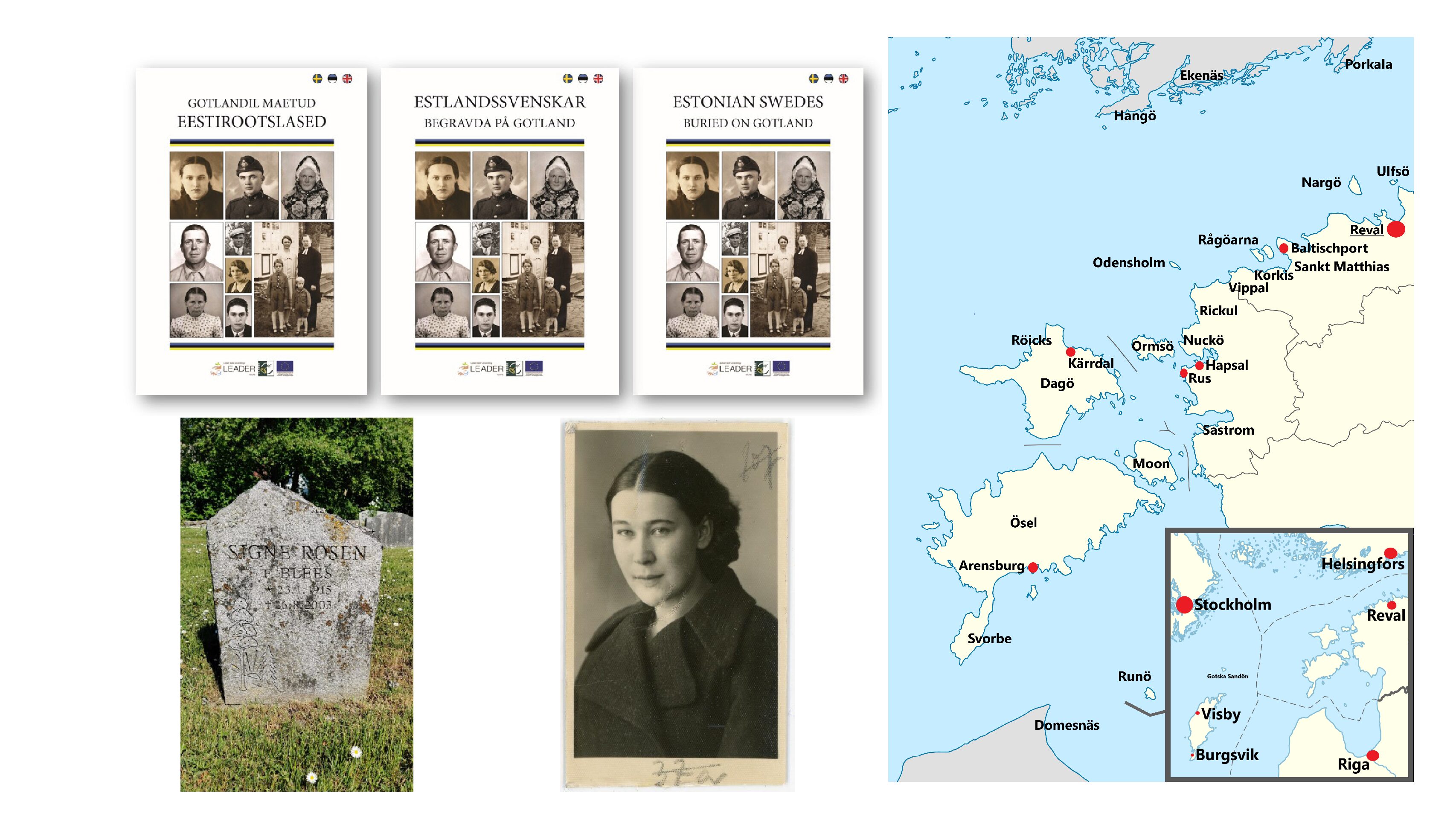
The information brochure titled ”Estonian Swedes buried in Gotland” is available, or will soon be available, in all 51 Gotland churches and chapels where Estonian Swedes are buried. The brochure has text in Swedish, Estonian, and English. Here is information about Estonian Swedes, the relationship between Gotland-Estonia, and a list of the buried individuals that the project has identified.
On the back of the brochure, there are QR codes to a database with more detailed information about the buried. There are also photographs of most of them.
The Gotland parish has also had the QR codes printed on aluminum plates to be placed outdoors in connection with the churches and chapels.
Within the project, a fallen gravestone of an Estonian Swede at Öja church has also been renovated.
Strong ties since the Middle Ages
– The contacts between Estonia and Gotland have a very long history. We know that Gutnish merchants traveled to Estonia during the early Middle Ages and also settled and became permanent residents there. During the Middle Ages, Gotlanders also pilgrimaged to the Estonian Swedish St. Olof's Chapel at Sastrom, which is located in Matsalviken inside Dagö. There were probably contacts even before the Middle Ages, says Christopher Thiele.
From the Middle Ages up to the 1900s, lively contacts occurred between Estonia and Gotland.
– During the 1800s, many came to Gotland to avoid the 25-year military service in the Tsar's army, and during the interwar period to work. People moved freely and frequently between the two places in the 1920s and 1930s, explains Christopher Thiele.
In the project ”From ai to åi,” it was necessary to limit itself solely to the 1900s; otherwise, it would have become too extensive. The Swedish village residents, who are originally the same ethnic group, were also not included in the material.
The project depicts a painfully dark epoch
The project encompasses around 200 buried Estonian Swedes who came to Gotland during the 1900s. The accounts that are partly found in the brochure, and in much more extensive form in the database, largely highlight a dramatic and painfully dark epoch in European history. Many of the human destinies that emerge give us a deeper understanding of this epoch – with stories that have been forgotten or suppressed.
– In connection with the emergence of the Soviet Union and the Iron Curtain, we somehow forgot our neighboring area – the Baltics – and what the Soviet state did there in terms of persecution, abuses, and deportations, says Christopher Thiele.
Many Estonians and Estonian Swedes fled to Gotland during World War II and the subsequent period under Soviet oppression.
– I have ancestors from both Estonia and Germany. Through this project and the personal stories we have uncovered, I now understand them in a completely different way. Why they did not want to talk about their backgrounds and terrible experiences, says Christopher Thiele.
Deported to Siberia
In the project's material, there is for example the story of the woman Signe Rosen (born Blees) who was allowed to come to Sweden in 1960 after having been deported to Siberia. She ended her life in a nursing home in Fårösund. Another woman experienced all the horrors of World War II and was forced into slave-like work picking weeds on Soviet farms, before she finally managed to escape to Gotland. Here there are also stories of several young Estonian Swedes who worked in Gotland before World War II, were called home for military service, and then during the Soviet occupation were arrested and taken to Siberia.
– In some stories, it also becomes clear how the Soviets hunted both Estonians and Estonian Swedes who had fled to Gotland, how these activities reached into Sweden and what fear this created. Our project opens a very unpleasant chapter about Europe's dark history – about things no one has talked about, says Christopher Thiele.
He also believes that many Gotlanders are unaware of their family ties to Estonia, and hopes that the project ”From ai to åi,” the brochure ”Estonian Swedes buried in Gotland,” and the QR codes to the database will help more people find these roots.
THE IMAGE ABOVE: Top left: The brochure ”Estonian Swedes buried in Gotland” in three languages. Bottom left: Signe Rosen (born Blees) was allowed to come to Sweden in 1960 after having been deported to Siberia. She ended her life in a nursing home in Fårösund and her gravestone is located at Etelhem Church. To the right: Map by Christopher Thiele. The map shows most of the main locations where the population was Swedish-speaking and in other words where those documented in the project were born.