That Liljeblads Möbelsnickeri sought support and conducted the course is rooted in the fact that the company's owner, William Liljeblad, has long seen the potential for intarsia within Gotlandic design.
– My interest in intarsia was born when I studied to become a furniture maker at Capellagården on Öland. Leif Burman came there and held such an inspiring training in intarsia. Leif is a master furniture maker, a university lecturer at Malmstens Linköping University, and an expert in intarsia, William explains.
When William then started his own furniture workshop in Vallstena on Gotland, he brought with him ideas about how intarsia could be used in his own design and production – e.g., as decoration on cabinets, dressers, and tables.
– Intarsia is a fantastic technique that fits perfectly for Gotlandic motifs! Everything from our historical buildings and landscapes to details in the plant kingdom and fossils.
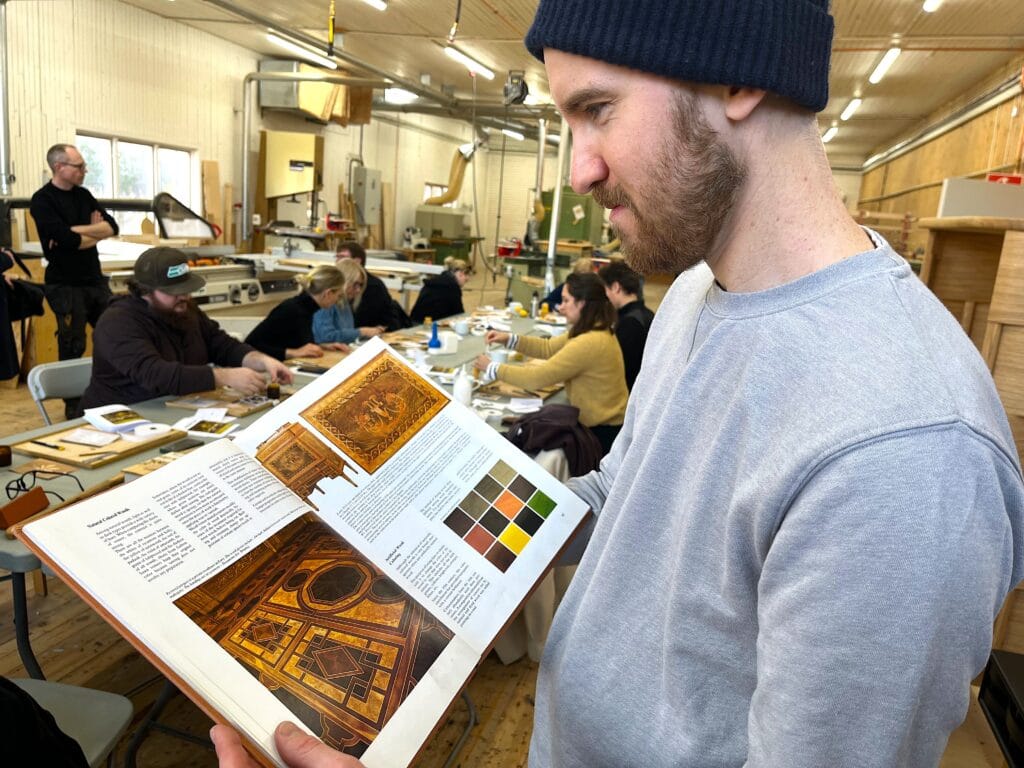
William Liljeblad studies the old masters of intarsia.
Local interest behind the course
In conversations with other furniture makers, designers, and artisans around the island, William encountered great curiosity about intarsia. Several were interested in learning the technique and saw opportunities to use it in exciting ways in their businesses.
– Against that background, I contacted Leif at Malmstens to shape a course with him here on the island. A sufficiently large and suitable venue for the course was also needed, and we could rent that from Ringvide Studio. When the project description and budget were ready, we applied for and were granted support from Leader Gute, William explains.
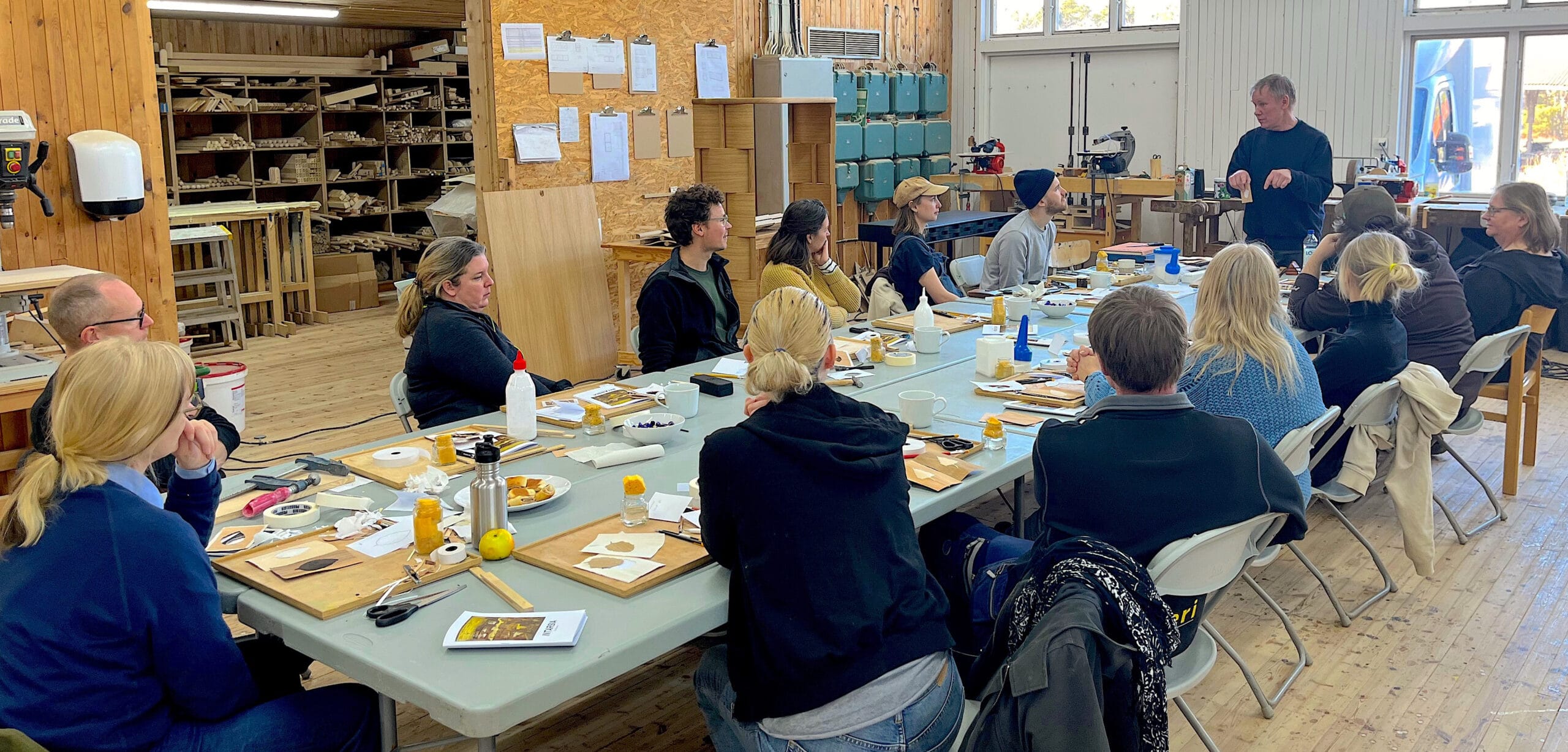
When the course started on Friday, March 21, 13 people had responded to the invitation. Most of the participants were professionals in carpentry, design, shaping, and crafts.
Short lectures – mostly practice
– The course began with Leif giving a historical background – how intarsia came to be, developed, and was used through different eras. He also described how his students at Malmsten nowadays work with intarsia with a modern touch and creative motifs. Then there were short lectures and mostly practical exercises on how to perform intarsia according to the most common methods, William says.
(Read more about the historical background of intarsia in the fact text below!)
Leif had brought the special precision saws used in intarsia and on a table there was an abundance of veneers of different wood species. The veneer was sawed according to Leif's instructions into pieces of various shapes. Then the participants learned to assemble the cut veneer pieces into patterns and apply them to wood materials for, for example, imagined furniture or craft products.
– The atmosphere and curiosity were at their peak! It became a very rewarding and appreciated course. All participants were very satisfied when we concluded the course on Sunday after three intensive days, says William.
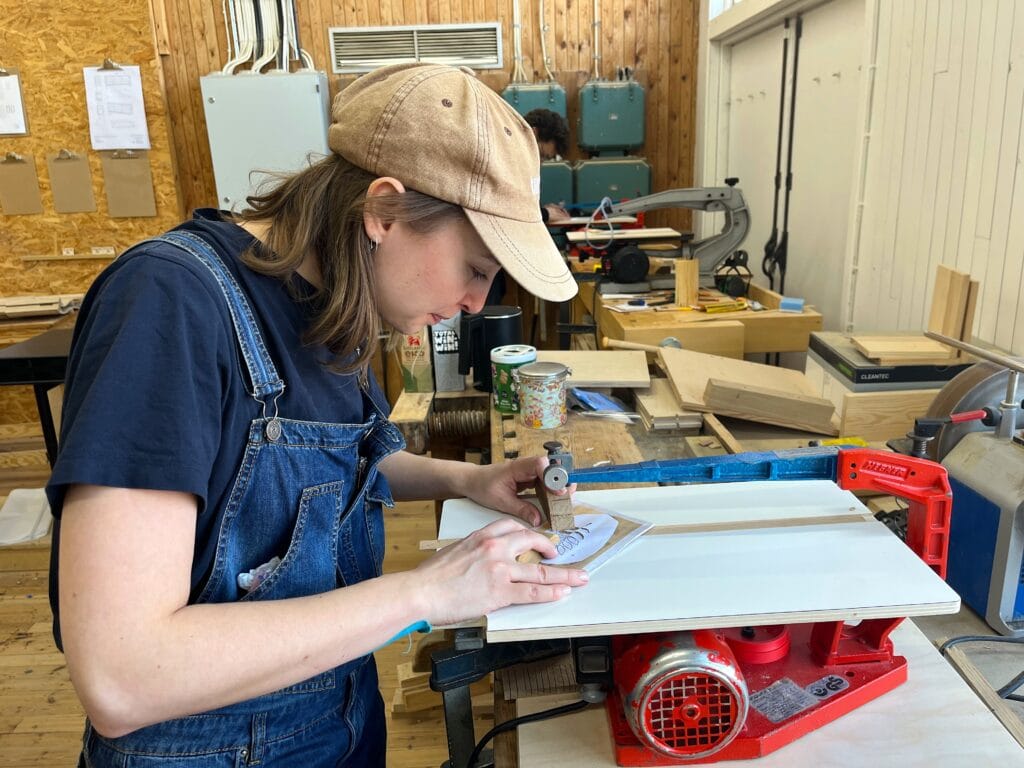
Cutting out parts in veneer for intarsia motifs with the special saw requires great precision and high concentration..
Plan for a follow-up course.
Several participants wanted to further develop their new knowledge in intarsia after the course and use the technique in their businesses within carpentry, design, shaping, or crafts.
– We already started discussing at the course conclusion about organizing a follow-up course soon. Perhaps we would then work particularly with motifs inspired by Gotland's architecture, culture, and nature. Maybe it could even become an exhibition, says William.
And the Gotlandic motifs actually appeared already during the now completed course; one participant made intarsia motifs with fishing villages and another chose Gotlandic churches as inspiration.
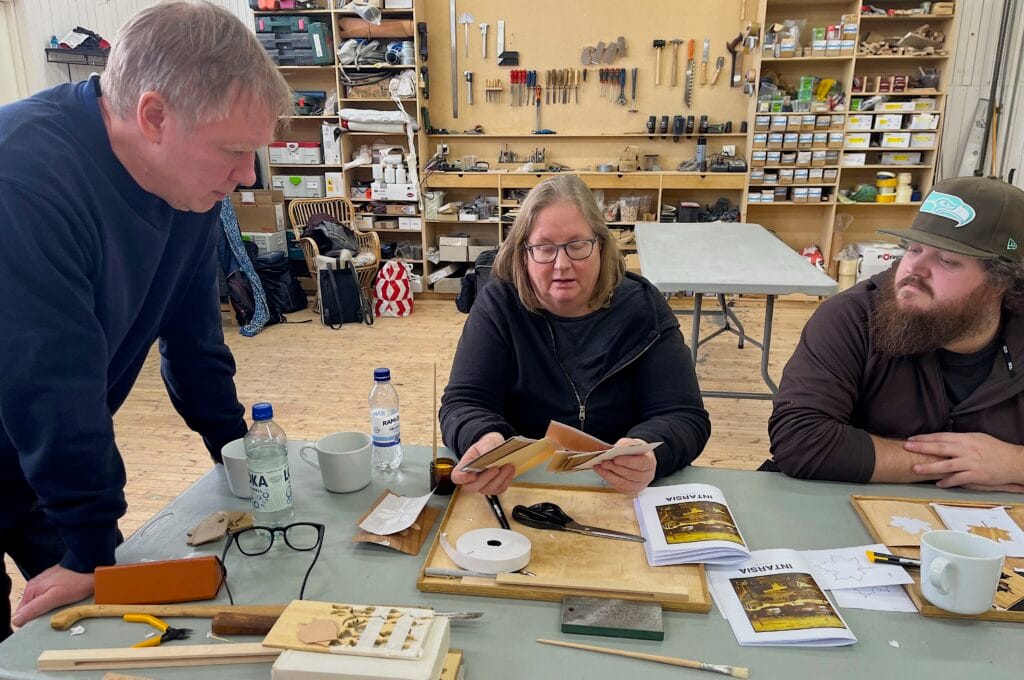
Teacher Leif Burman gives instructions to the participants during the course. Leif is a master carpenter, university lecturer at Malmsten Linköping University, and an expert in intarsia.
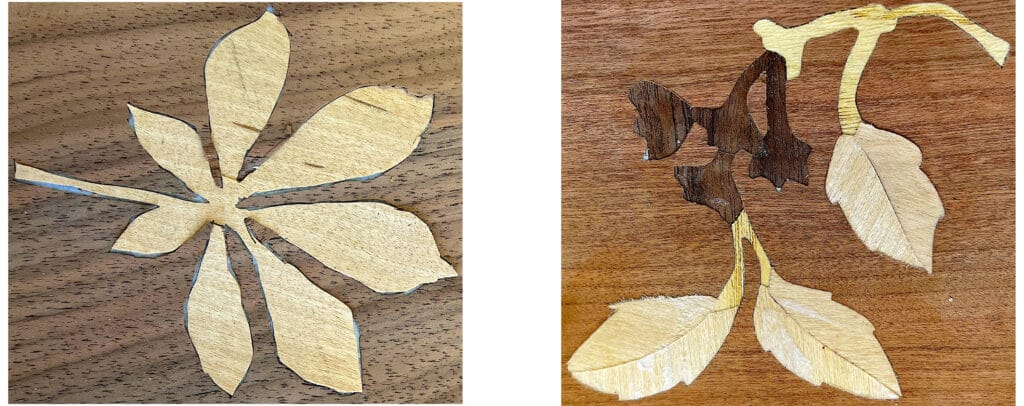
The course participants made rapid progress and already on the first day, fine initial works were created such as these, see below.
Facts about intarsia.
- Intarsia is a wood processing technique where wood veneers are joined together to create decorative motifs on, for example, furniture or in crafts. Practitioners of intarsia are called ”dekopör” – formerly a guild that even had its own greeting, where they shook hands with the same grip as when using the special saw for intarsia. (During certain periods, a form of intarsia with materials other than wood also occurred, such as inlays of mother-of-pearl, ivory, and metal.)
- Already in antiquity, surfaces were decorated with this technique. It is described by Pliny the Elder, who lived from 23–9 BC.
- During the 1300s, the first modern intarsia was made in Italy.
- Intarsia experienced a resurgence during the Renaissance – especially in Italy. A famous example is the decoration in Palazzo Ducale in Gubbio (late 15th century).
- In 1562, the first scroll saw was invented. The new sawing technique made it possible to create more complicated patterns. Now the technique spread and became popular across large parts of Europe. King Erik XIV's chambers from the 1560s at Kalmar Castle are a magnificent example.
- The ”golden age” of intarsia occurred, according to many, during the 18th century. The most famous representative was the German furniture artist David Roentgen. He invented the revolutionary technique for conical fitting of motifs in intarsia. During the later part of the 18th century (late Rococo and early Neoclassicism), Roentgen delivered luxurious furniture to the European princely houses. Often with secret compartments, intricate mechanical devices – and intarsia.
- Various techniques and expressions within intarsia have developed in different places around the world. Among other things, there is a special Japanese technique – which is primarily found in Japanese woodwork from the 19th and 20th centuries.
- Interest in intarsia has fluctuated somewhat through different eras. In Sweden, Carl Malmsten used intarsia in his furniture from the 1910s. Around the same time, C G Pettersson also used intarsia in his well-known wooden boats.
- With modernism and functionalism, when steel, plastic, and other materials became more common in furniture production, intarsia became less common. But the technique has never disappeared – new ideas about how intarsia can be used and shaped have continuously emerged.
(Sources: William Liljeblad, Nationalmuseum and Wikipedia)