This has emerged in the SI-funded project Regenerative Blue Food Tourism coordinated by Leader Gute. Here, important opportunities and obstacles for creating the model have also been outlined. The work now continues with fishermen, restaurateurs, and other stakeholders.
Locally and transnationally
Regenerative Blue Food Tourism is both a local and transnational project. It started in November 2025 and will run until the end of 2027.
The starting point for the project is to explore the possibilities of regenerative blue food tourism in Gotland and other islands and coastal communities around the Baltic Sea.
In addition to Gotland and Leader Gute, actors from Estonia, Lithuania, and Denmark are participating.
Each partner country in the project has established local so-called ”CoP:s” (Community of Practices). In Sweden's case, this is on Gotland. These CoP:s consist of local representatives from civil society, the private sector, and the public sector. They will explore in an open and innovative way how to create, package, and market regenerative blue food experiences primarily during the low season.
Through transnational cooperation, CoPs from the participating countries will form a common network and learn from each other, primarily through various study visits.
– By working locally based on slightly different opportunities, challenges, and setups, and then sharing experiences transnationally, we achieve rich learning together, says Ellen Lundqvist, the operations manager at Leader Gute and project manager for Regenerative Blue Food Tourism.
Exciting start in Gotland – three main points
The first local CoP meeting in Gotland was held on January 19 in Visby. Representatives from fishing, restaurants, the County Administrative Board, Region Gotland, and other actors connected to blue industries on the island participated.
After a review of the project's purpose and goals, there were group discussions on how the project can be driven locally for positive development in Gotland – and what the actors see as needs and what they can contribute.
The meeting concluded with a joint discussion in plenary. In summary, the participants landed on the following three main points:
Renovate and develop the entire chain for local and regenerative blue food in Gotland! Catching–handling–processing–distribution–consumption.
Advocate and elevate status – we must show that our Gotland fish has value and that more people are interested in it than we often believe. Butterfish and stickleback are exciting areas for development – for example, as fish sauce.
Work for a long-term and cohesive blue/green Baltic gastronomy and how it can be realized in Gotland.
Relationship building between fishermen and chefs
The second CoP meeting was held on March 5 at Gotland Grönt Centrum in Roma – also here with a broad local representation on the subject. During the meeting, the main points raised during the initial meeting were specified.
It was established here that relationship-building efforts between fishermen and buyers – primarily restaurants – are a central issue. Chefs and fishermen need to meet to understand each other's situations and needs. For example, many restaurants want fresh turbot, but it is only fished for two weeks a year. Therefore, it needs to be smoked or frozen if restaurants are to have greater access to Gotland turbot.
The project will work for this relationship building, not least through meetings between fishermen and chefs. Activities such as Matbyråns Talk, create, taste can also become a forum for meetings between fishermen and chefs.
Processing, events and gastronomy
During the second CoP meeting, it was also mentioned that processing of food fish in Gotland could be an opportunity for driven entrepreneurs. Östersjömat in Vamlingbo is already engaged with canned herring. Could there be support to apply for the establishment of a larger canning factory? The fishermen also need support for investments to develop fishing.
An important message to convey is the significance of local fishing for preparedness.
The closing conference and seminars within Regenerative Blue Food Tourism could be used to inform about and elevate the status of blue Gotlandic food.
Local blue food as a gastronomic experience could also be linked to a potential future gastronomic education on the island and a project application regarding regenerative meal experiences that Matbyrån and Gotlands Förenade Besöksnäring are currently working on.
Here, the regenerative recipe collection regarding blue food developed within Regenerative Blue Food Tourism could also be an asset.
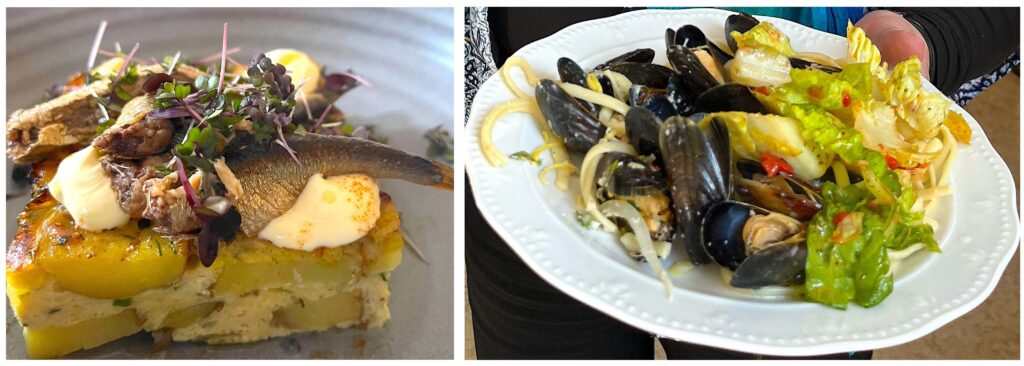
During the CoP meeting at Broman & Son, herring was served, and during the meeting at Gotland Grönt Centrum, mussels were served.
An intermediary – a key issue
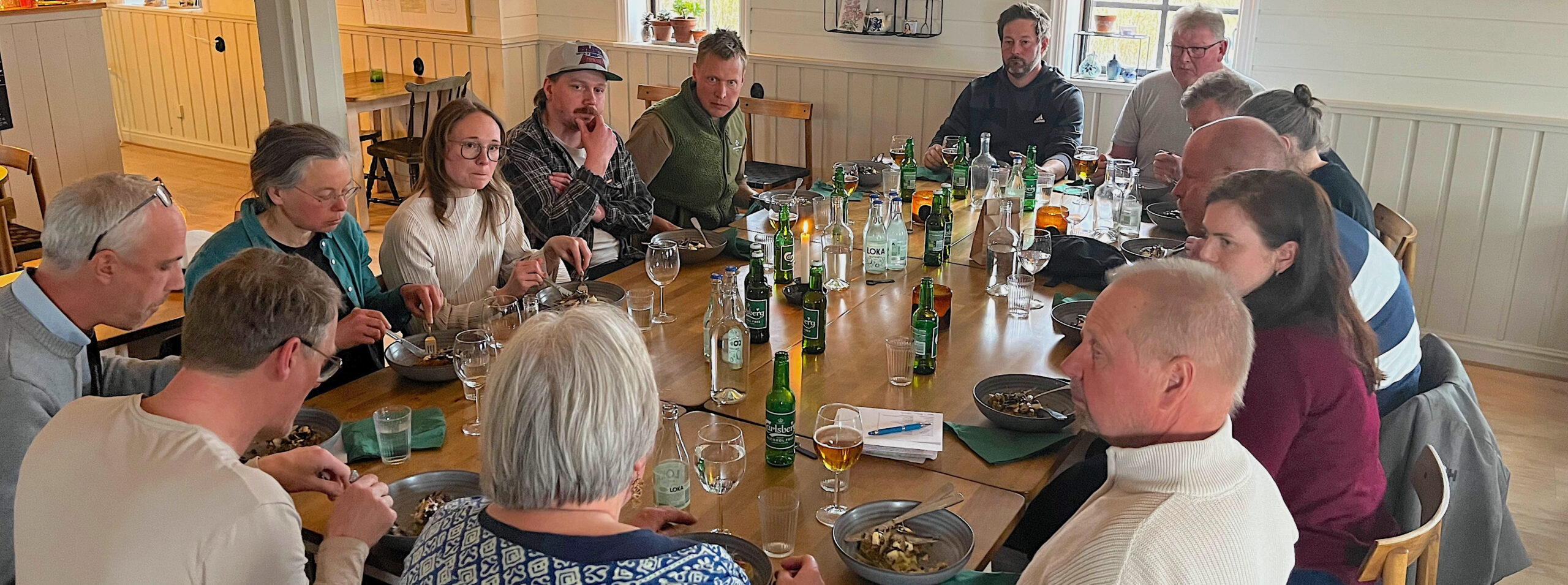
The third CoP meeting on the island was held at Broman & Son in Gnisvärd. (See the image at the top of this feature). Several fishermen and chefs participated, as well as a representative from the wholesaler Gotlandsspecialisten. And, as always, various actors from civil society, the private sector, and the public sector.
During the meeting, it became clear that there is interest among both fishermen and restaurateurs in Gotland to jointly develop a new model for local food from the sea. A model that can make the island both more sustainable and attractive to visitors.
Several fishermen want to sell fish to local restaurants, and the restaurants want to buy, but delivery is currently difficult to arrange. It was also noted that there is a growing interest among people to eat local food and local ”odd” fish. Especially if it is sold in a fun/inspiring way with an emphasis on it being Gotlandic locally caught fish.
For this to work practically, the fisherman needs to receive relatively large orders from the restaurateur, and the restaurateur needs to be able to freeze the raw material.
Establishing a local intermediary between the fisherman and the restaurateur – and eventually also store/consumer – is a key issue. There needs to be ”short distances” between the sea and the customer. This means that some actor needs to take on the role of this intermediary, which includes cutting/filleting, freezing, delivery, and contact with restaurant/store. A possible project would be to test the function of such a logistical and administrative intermediary. This way, one could test against the restaurant and see where it leads.
The project is now moving forward with additional local CoP meetings, study trips, and exchanges between the participating countries.
The next step is a study trip to Estonian Ösel, where 22 participants from Denmark, Sweden, Lithuania, and Estonia will conduct study visits and exchange experiences as well as workshop on how, among other things, silver bream, stickleback, and butterfish can be used as part of a regenerative taste experience.

Silver bream, stickleback, and black-mouthed butterfish are fish species that can be used in regenerative local blue food.
Facts about the project:
o The project's formal name in its entirety is: Regenerative Blue Food Tourism – Explore possibilities for off-season blue food tourism in the Baltic Sea Region.
o Regenerative tourism is a way of traveling that aims to give back more than it takes to local communities and the environment. This can, for example, happen by tourists actively engaging in local projects or seeing themselves as part of nature rather than just as consumers.
o In this project, the aim is to create concepts where producers of sustainable local blue food (fish, seafood, and algae) collaborate with restaurants and other actors to offer visitors exciting culinary experiences that contribute to improving local places and environments related to the sea and the blue economy.
o The project is funded by the Swedish Institute with 2 million kronor and runs from November 2025 to December 2027.
o The purpose of the project is to explore and develop a local-transnational method for regenerative blue food tourism during the off-season in the Baltic Sea region.
The following countries and islands/coastal communities are participating – lead organization for each country in brackets:
Sweden – Gotland (Leader Gute – also coordinator for the entire project)
Estonia – Ösel (Tartu University, Marine Biological Centre)
Lithuania – Klaipeda (Klaipeda Chamber of Commerce, Industry and Crafts)
Denmark – Funen, (University of Southern Denmark) participates to a limited extent
Read more here:
The activities and various results within the project and all participating countries/islands are communicated continuously on a common platform that you can access via these links:
Facebook page
LinkedIN page